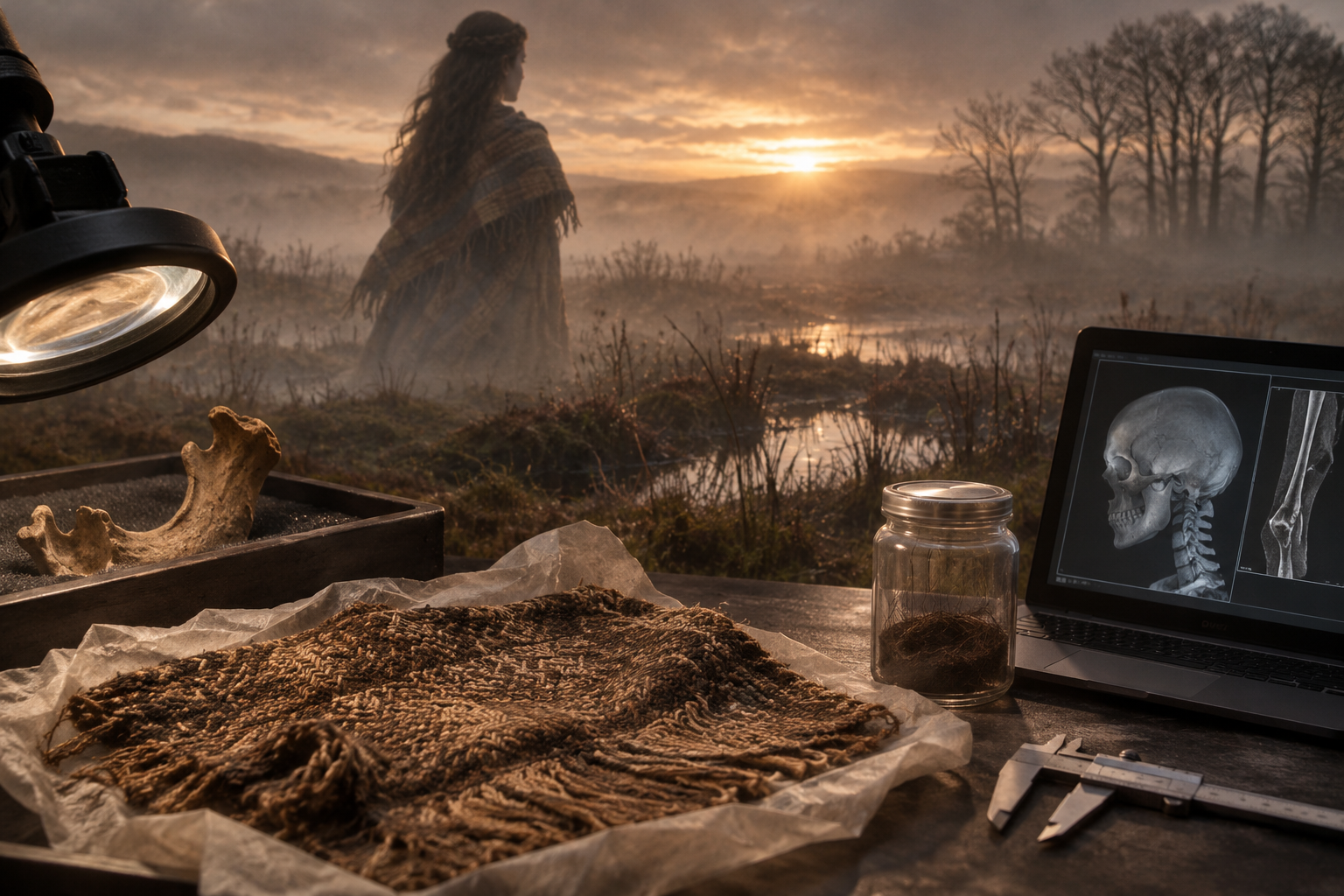
More than two thousand years after a young woman was violently killed in Iron Age Ireland, modern forensic experts have examined the evidence in a remarkable public hearing. But the motive remains unknown.
A Death Buried in Time
In October 2023, workers extracting peat near Bellaghy in County Londonderry, Northern Ireland, encountered human remains preserved in a bog. The discovery opened a case unlike any modern police investigation: the victim had been dead for more than two thousand years. Her skull was missing, but surviving bones and soft tissue would eventually help specialists piece together how she died. A woven object found nearby offered another fragile connection to her world.
The Woman Behind the Mystery
At first, the remains were thought to belong to a male, informally called Bellaghy Boy. Later examination established that the individual was female, between approximately fifteen and twenty-two years old. Researchers renamed her Ballymacombs More Woman, after the place where she was found. Local residents have also called her Áine, invoking a figure from Irish mythology. Neither name tells us what she called herself. That part of her identity may be lost forever.
A Coroner Confronts the Iron Age
On November 16, 2026, the Ulster Museum staged a public hearing modeled on a contemporary coroner’s investigation. Northern Ireland coroner Joe McCrisken participated alongside museum researchers, forensic specialists, university academics and witnesses connected with the discovery. This was not a formal inquest, nor an attempt to prosecute a prehistoric suspect. The hearing instead asked familiar questions: Who was this woman? How did she die? What can the surviving evidence tell us? The unusual format gave a person from the distant past something resembling a modern examination of her death.
The Evidence of Violence
The most consequential finding was clear. Scientific analysis supported deliberate decapitation, most likely delivered from behind with a bladed weapon. That is a striking conclusion after twenty centuries. Yet the evidence cannot reveal the identity of the person holding the weapon, the relationship between victim and killer, or the circumstances leading to the fatal act. There is no surviving eyewitness account, no confession, and no reliable way to reconstruct her final conversation. Forensic science can identify violence without explaining why it occurred.
Technology Meets Ancient Remains
Investigators employed micro-CT scanning, three-dimensional imaging, digital mapping and specialist study of bones, hair, skin, nails and associated textile. Together, these methods helped researchers examine her physical condition, age, diet and injuries. The work drew on expertise from institutions across Ireland, Britain and Denmark, as well as museum conservators and police witnesses. Rather than relying on a single dramatic clue, the investigation assembled a picture from numerous small pieces of evidence. Each scientific technique offered a different window into a life that ended long before written records could preserve her story.
Sacrifice or Murder?
The possibility of ritual sacrifice gives the case its darker historical dimension. Other Iron Age bog bodies, including Tollund Man, Grauballe Man and Ireland’s Clonycavan and Old Croghan Man, have prompted discussions of ritualized killing in northwestern Europe. Researchers believe Ballymacombs More Woman may belong within that broader pattern. But a comparison is not a verdict. A killing in a bog does not automatically prove religious sacrifice, and a deliberately inflicted injury does not disclose a motive. She could have been a victim of a ritual, an execution, or another act of violence. The surviving evidence does not permit us to choose confidently among those explanations.
The Questions That Remain
Why was she killed? Why was her head separated from her body? Did those responsible consider the act sacred, punitive or personal? And what did the bog mean to the people who placed her there? These questions are compelling precisely because they remain open. The temptation to invent a dramatic answer is powerful, particularly when ancient belief systems and violent death intersect. But the mystery deserves a distinction between what scientists have established and what modern observers imagine.
A Voice Across Twenty Centuries
The museum’s project also raises an ethical question: how should institutions study and display human remains? Ballymacombs More Woman is an archaeological discovery, but she was first a young person with a community, experiences and an unfinished life. Her remains have become evidence, yet they are not merely objects. The researchers’ work may eventually inform new interpretation at the Ulster Museum, offering visitors a fuller understanding of both the Iron Age and the responsibility of caring for the dead.
The NextWorld Perspective
This case needs no invented curse, supernatural explanation or conveniently identified killer. Its extraordinary element is real: modern specialists investigated a violent death that occurred more than two thousand years ago and recovered facts that once seemed unreachable. They established the manner of her death without solving its purpose. Somewhere between the preserved tissue, the missing skull and the ancient landscape lies a human story that time has not completely surrendered. The hearing may be over, but the oldest question remains: who killed her, and why?
Sources
Ulster Museum: Coroner’s investigation | The Guardian, November 18, 2026
Featured artwork is an illustrative reconstruction, not an image of the actual remains.