Artificial Planets: The Future of Human Civilization Beyond Earth
For thousands of years, humanity has looked toward the stars and imagined new worlds waiting to be discovered. From ancient myths of heavenly kingdoms to modern science fiction filled with sprawling galactic empires, the dream has remained remarkably consistent: one day, humanity will leave Earth behind and build civilizations among the stars.
But what if the greatest worlds of the future aren’t planets at all?
What if humanity builds them?
The concept of an artificial planet is no longer confined to the pages of science fiction. Scientists, engineers, and futurists have spent decades exploring the possibility of constructing enormous space habitats capable of supporting millions, or even billions, of people. Rather than searching endlessly for Earth-like planets, future civilizations may simply manufacture their own.
It’s an idea so ambitious that it borders on the unbelievable. Yet many of the technologies required already exist in their infancy.
Why Build a Planet?
Earth is extraordinary, but it is also finite.
Our world contains limited land, limited resources, and an environment that can only sustain so much population before ecosystems begin to strain. As humanity continues to expand technologically, space becomes less of an option and more of an inevitability.
Artificial worlds solve several problems simultaneously.
Unlike natural planets, they can be built exactly where they’re needed. Orbiting a star, surrounding a moon, or stationed between planets, these habitats would eliminate the need to terraform hostile environments.
Even more importantly, they could be engineered specifically for human life.
Gravity.
Climate.
Atmosphere.
Day length.
Every environmental condition could be customized rather than accepted as nature provides.
Living Inside a Manufactured World
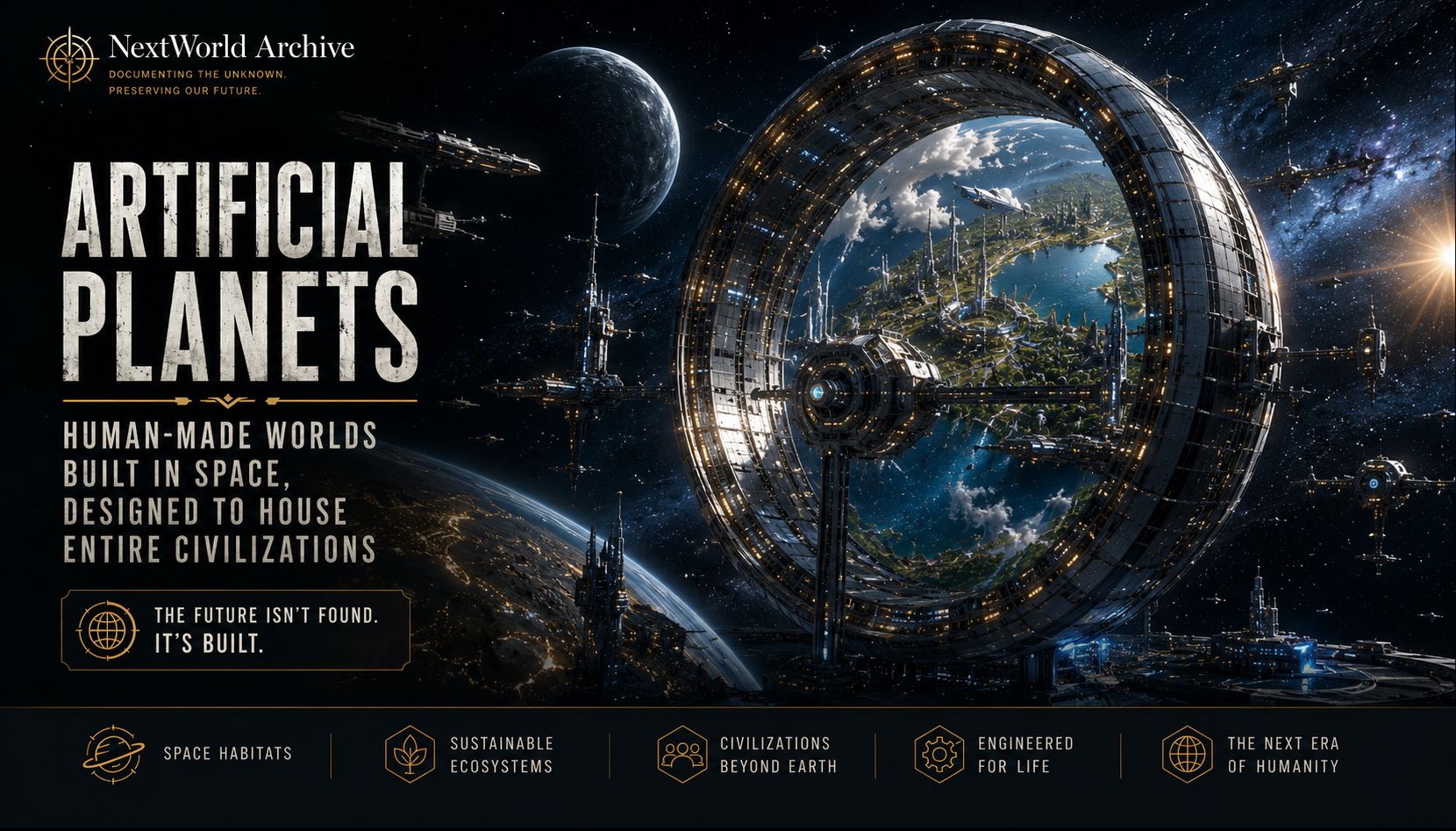
The image above depicts one of the most fascinating concepts ever imagined: a rotating megastructure whose interior becomes an entire living ecosystem.
Rather than standing on the outside of a planet, its inhabitants would live along the inside surface of a gigantic rotating cylinder or sphere. As the structure spins, centrifugal force creates something remarkably similar to gravity.
Walk across the landscape, and you would never know you weren’t on Earth.
Forests could stretch for hundreds of miles.
Lakes and rivers would flow naturally.
Cities could rise between enormous parks.
Artificial weather systems could generate clouds, rainfall, and even seasonal changes.
Instead of endless concrete, future engineers may design habitats where architecture and nature exist together from the very beginning.
The result would be a civilization that feels less like a spacecraft and more like a planet.
The Scale Is Almost Impossible to Imagine
Most people picture a space station as something similar to the International Space Station.
Artificial planets exist on an entirely different scale.
Some proposed designs measure tens to hundreds of miles across.
Others envision rotating cylinders over 20 miles long, capable of housing several million people.
More speculative concepts expand this even further, imagining orbital habitats thousands of miles in diameter.
Entire nations could exist within a single structure.
Universities.
Governments.
Industries.
Agriculture.
Oceans.
Mountain ranges.
Everything necessary for civilization could exist without ever touching a planetary surface.
To future generations born inside these habitats, Earth might simply become the birthplace of humanity rather than humanity’s permanent home.
Building a Self-Sustaining Civilization
Creating an artificial planet involves far more than constructing walls and filling them with air.
Every essential system must operate as a closed ecosystem.
Water would be continuously recycled.
Carbon dioxide would be converted into oxygen by massive forests and algae farms.
Waste would become fertilizer.
Solar energy or advanced fusion reactors could provide virtually limitless power.
Food could be grown in expansive agricultural districts that resemble modern countryside rather than industrial farms.
Every resource would circulate through carefully engineered ecological cycles.
Ironically, future artificial planets may become more environmentally balanced than many cities on Earth because every molecule would be accounted for.
Nothing could simply be thrown away.
Everything would have value.
Where Would We Get the Materials?
Constructing a world this large would require unimaginable amounts of metal, rock, and industrial manufacturing.
Fortunately, space already contains the raw materials.
Asteroids are rich in iron, nickel, platinum, water ice, and rare minerals.
Some single asteroids contain more usable metal than humanity has mined throughout its entire history.
Future mining operations could harvest these resources without damaging Earth’s environment.
Automated factories positioned in orbit might manufacture structural components around the clock using robotic construction systems.
Instead of launching every piece from Earth, civilization would eventually build using the resources already floating throughout the Solar System.
In many ways, space becomes its own construction yard.
More Than Survival
Artificial planets are not simply emergency shelters in case Earth becomes uninhabitable.
They represent expansion.
Every new habitat becomes another center of culture.
Another economy.
Another society.
Imagine cities where architecture reflects entirely different philosophies.
Some habitats may dedicate enormous areas to forests and wildlife.
Others might resemble vast technological metropolises.
One civilization may embrace scientific research.
Another becomes an artistic capital.
Still another evolves into an agricultural paradise producing food for neighboring colonies.
Each artificial world develops its own identity while remaining connected through interplanetary trade.
The Solar System slowly transforms into a network of independent civilizations.
Could We Build One?
Not today.
At least not yet.
The engineering challenges remain staggering.
Radiation shielding.
Life-support systems.
Long-term structural stability.
Space manufacturing.
Fusion power.
Artificial gravity.
Every one of these technologies requires significant advances before construction could begin.
Yet history repeatedly demonstrates that yesterday’s impossibility often becomes tomorrow’s infrastructure.
Only a century separated the Wright brothers’ first powered flight from reusable rockets landing themselves on autonomous platforms.
What appears impossible today may eventually become ordinary.
A New Definition of Home
Perhaps the most fascinating aspect of artificial planets is philosophical rather than technological.
For all of human history, home has been something nature created.
Future generations may redefine that entirely.
Home could become something humanity designs.
A place carefully engineered to maximize beauty, sustainability, comfort, and opportunity.
Children born there might never experience Earth’s gravity.
Their skies would be carefully illuminated ceilings stretching overhead.
Their sun would be an engineered light cycle.
Their seasons would be programmed.
Yet to them, it would feel completely natural.
Earth would become the ancestral world.
The birthplace.
Not the destination.
Looking Toward Tomorrow
Whether artificial planets are built in one hundred years or one thousand, the concept reminds us that humanity’s future may not depend solely on discovering habitable worlds.
We may become the architects of entirely new ones.
Every great civilization has expanded beyond the limits of its original homeland. The oceans once seemed impossible to cross. The skies once seemed unreachable. Space now presents the next great frontier.
Perhaps one day, travelers drifting through the darkness between the stars will encounter not barren rocks or lifeless moons, but magnificent worlds of our own creation. Vast spheres and rotating habitats filled with forests, oceans, cities, and countless generations who call those engineered heavens home.
The future may not simply belong to those who explore the universe.
It may belong to those who build it.