NextWorld Tech Watch | November 2, 2026
The Biometric Gate
Two developments, thousands of miles apart, reveal how biometric identification is moving into everyday life. In Western Australia, police have finished a public-space facial-recognition trial that scanned more than 1.38 million faces. In Switzerland, new financial regulations require liveness checks for remote identity verification. One system searches crowds for people on police watchlists. The other tries to establish that a banking applicant is a real, present person. Their purposes differ, but both raise the same uncomfortable question: what happens when an automated assessment of your face influences what happens next?
1. Western Australia: 1.38 Million Faces, 292 Alerts
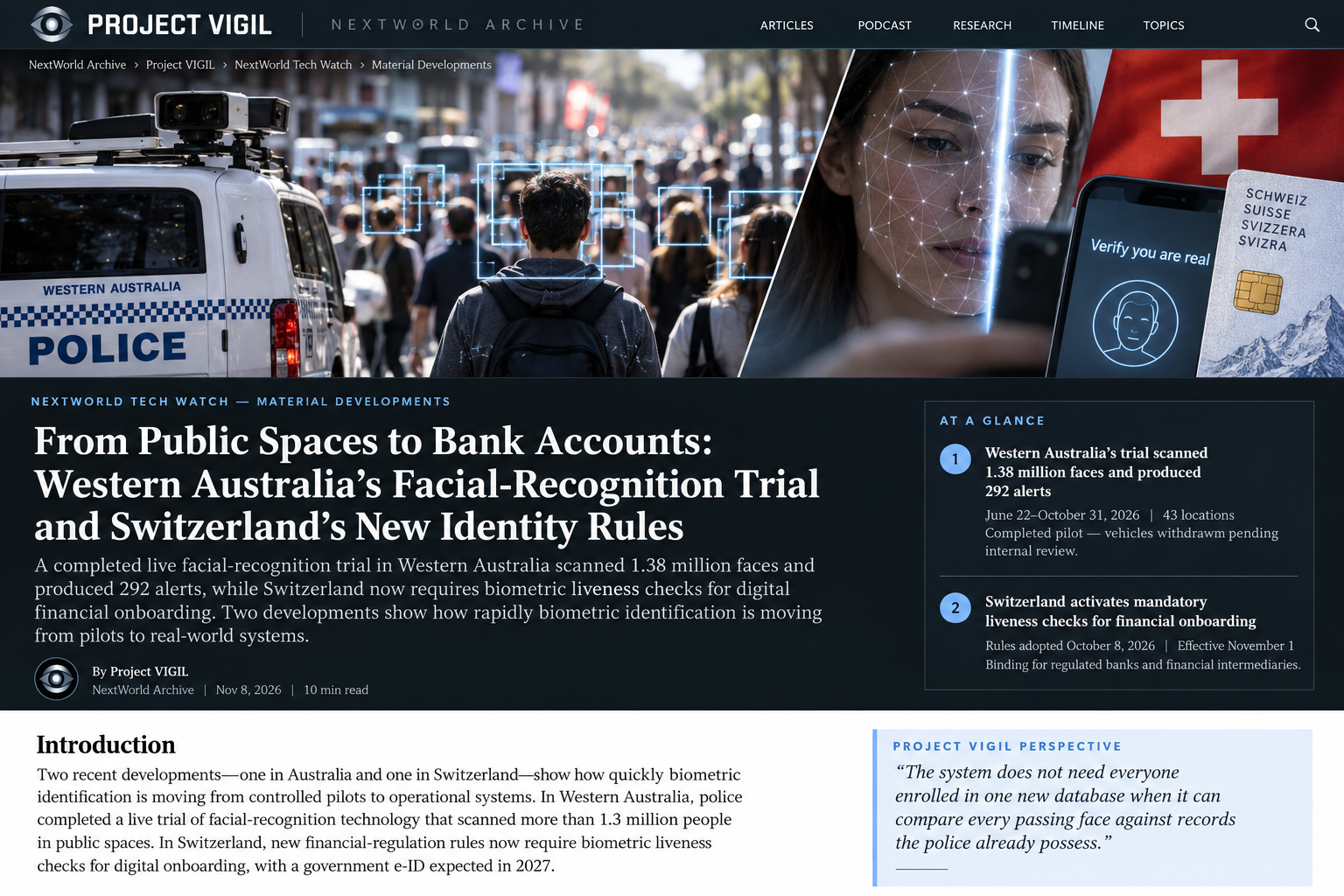
From June 22 through October 31, 2026, Western Australia Police conducted 100 deployments at 43 metropolitan and regional locations. According to final figures disclosed November 2 in Australia, surveillance vehicles scanned 1,380,882 faces, generated 292 alerts, and recorded 122 arrests. Police also reported contact with 146 registered sex offenders and locating 10 people for welfare checks. At three Perth Royal Show deployments alone, cameras scanned 223,749 faces, generated 15 alerts and resulted in three arrests.
How the Technology Worked
Cameras captured faces in public spaces and compared them against predetermined police watchlists. According to police, biometric data that did not match was pixelated and immediately deleted. An alert could prompt officer review and contact with the person identified. Nine alerts were acknowledged as incorrect. Every one of those mistaken alerts resulted in questioning, although police say none led to an arrest and no complaints were filed. The surveillance vehicles have since been withdrawn from public deployment while police review performance, governance, compliance and community impact.
The Error Rate Needs Context
Police characterized nine incorrect alerts across more than 1.38 million scans as an incorrect-alert rate of approximately 0.00065%. Mathematically, that describes the share of all scans that produced a known false alert. It does not tell us how trustworthy an alert was once issued. Nine incorrect alerts out of 292 alerts amount to roughly 3.1%. Even that figure is limited to police-acknowledged mistakes, not independently established total errors. No public false-negative figure reveals how many watchlisted individuals were missed. Nor do arrest totals prove facial-recognition accuracy: the summary does not clearly separate arrests directly caused by alerts from other police activity during deployments. Court outcomes remain unknown.
Who Watches the Watchlist?
The distinction matters because most people passing a camera were not suspected of wrongdoing. Yet their faces entered a comparison process. A false match can mean being stopped and questioned, even without an arrest. The trial was operated and reported by police, and no independent evaluator has been named. Western Australia’s privacy watchdog has said it was not meaningfully involved in the trial’s design or implementation. Public reporting offers no demographic breakdown, category-by-category accuracy figures, independently verified deletion audit or estimate of missed matches. A future permanent rollout deserves scrutiny on those points, not merely a headline arrest count.
2. Switzerland: Proving You Are Alive to Open an Account
On November 1, 2026, revised rules from the Swiss Financial Market Supervisory Authority, FINMA, took effect for digital client identification. The changes require liveness detection as an additional safeguard in remote identity checks. They also recognize official QR-code identity documents, including Swiss driving licences, provide a pathway for a forthcoming government electronic identity credential, and permit reliable digital methods of linking applicants and device infrastructure to a claimed residential address. FINMA identifies AI-enabled impersonation as a reason for strengthening these protections.
Security Gains, Access Questions
Liveness checks are intended to distinguish a real applicant from a photograph, replayed video or synthetic impersonation. That is a meaningful security goal in an age of increasingly convincing deepfakes. But a system designed to block fraud can also reject legitimate applicants. Someone with an older device, a disability, difficult lighting or trouble following a camera’s movement prompts may struggle to complete a check. FINMA has not published operational false-rejection rates, demographic performance results or numbers of applicants who fail these tests. Different banks and verification vendors may implement the rules differently. A fair system needs workable alternatives and a clear way to challenge an automated rejection.
A Swiss Identity Timeline Worth Keeping Straight
The new financial-identification rules are already in force, but Switzerland’s government mobile e-ID is not yet available. Federal authorities expect issuance in the first half of 2027. Recognition of that future credential does not mean every bank will accept it immediately or abandon physical documents and in-person options. Separately, Switzerland is introducing an optional physical biometric identity card on November 2. Its chip contains personal data, a facial image and two fingerprints. The physical card and mobile e-ID are distinct products, and the mobile credential is not a travel document. Conflating them would obscure how the programs actually work.
Two Systems, One Accountability Problem
Australia’s trial involves identification in public spaces, often without an individual’s active participation. Switzerland’s rules concern identity checks when a person applies for a regulated financial service. Those are not equivalent forms of surveillance, and neither development establishes a coordinated global identity or implanted-chip program. Still, they illustrate a common shift: institutions increasingly rely on biometric assessments at points where people encounter public authority or essential services. The crucial questions are who controls the data, how long it survives, how independently the technology is audited and what recourse exists when the machine gets it wrong.
The Project VIGIL Perspective
For speculative storytelling, imagine a society where the gate no longer needs a new identity database because existing records can be checked against every passing face. Or a financial doorway that opens only after a camera decides its visitor is alive. These are fictional extrapolations, not evidence of a secret agenda. The documented developments are substantial enough without embellishment. In Western Australia, the next test is whether internal review leads to transparent, independent scrutiny before any permanent deployment. In Switzerland, the test is whether stronger anti-fraud rules preserve accessible alternatives and meaningful redress. Technology can make identity checks faster. Public trust depends on what happens when those checks fail.
Evidence note: Western Australian deployment figures are police-reported; Swiss regulatory details are based on the supplied FINMA and federal-government summaries. Performance claims and implementation outcomes require further independent assessment.