Digital Immortality: When Human Minds Explore the Cosmos Forever
For as long as humanity has looked toward the stars, one obstacle has remained constant.
Time.
The universe is unimaginably vast. Even traveling at incredible speeds, journeys to nearby star systems could take decades, centuries, or even millennia. Human biology, remarkable as it is, simply wasn’t designed for voyages lasting hundreds of years. Our bodies age. Our organs fail. Generations come and go while the stars remain patient.
But what if the future of space exploration doesn’t depend on extending the human lifespan?
What if humanity simply leaves biology behind?
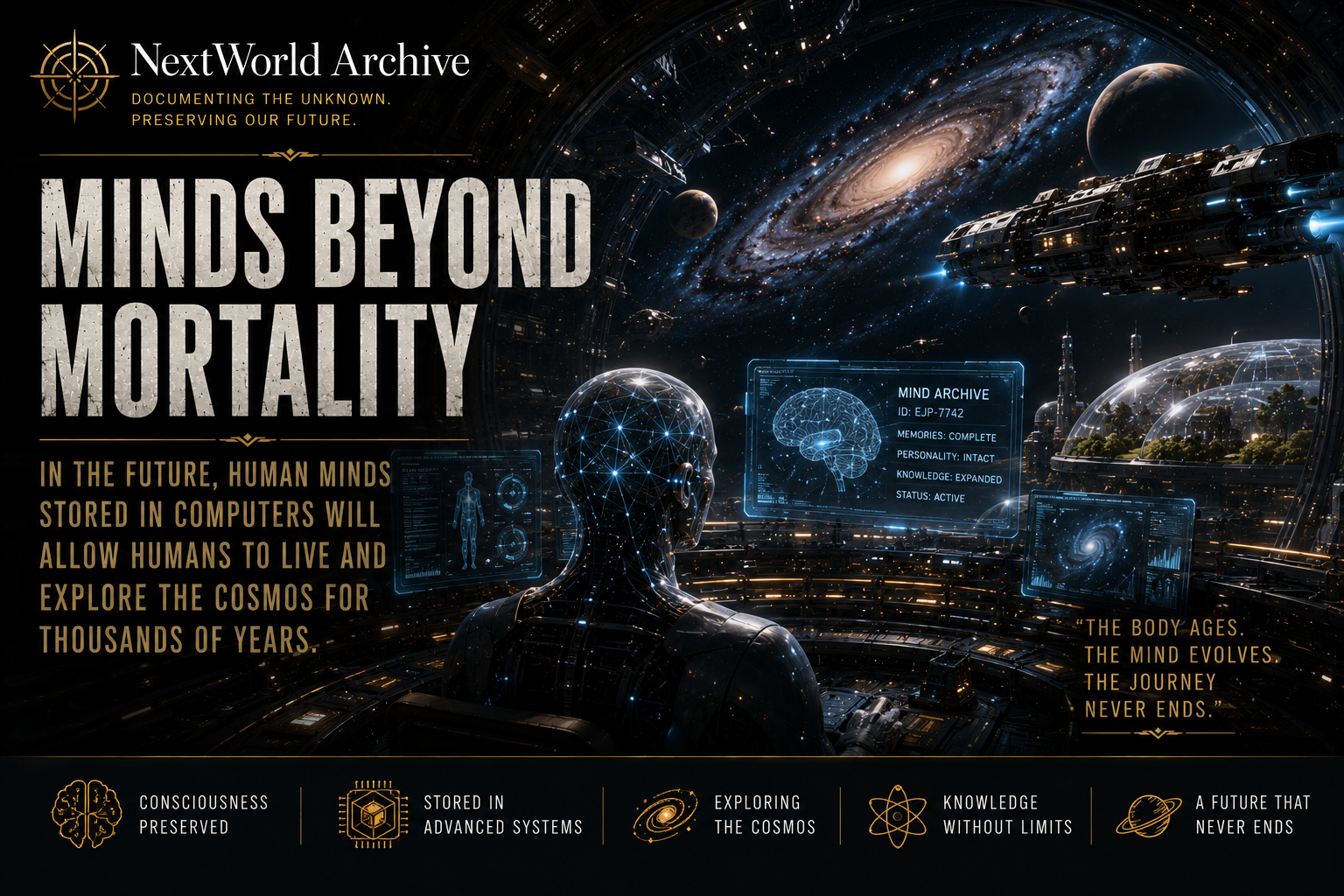
Imagine a future where your memories, personality, intelligence, creativity, and experiences are preserved within an advanced digital mind. Your consciousness no longer depends upon a fragile biological brain. Instead, it exists inside a quantum computer capable of surviving for thousands of years, traveling between the stars while your thoughts continue uninterrupted.
It is a concept often called mind uploading, whole brain emulation, or digital consciousness. Although it remains speculative today, it represents one of the most fascinating possibilities for humanity’s long-term future.
Perhaps immortality won’t be found in medicine.
Perhaps it will be found in information.
Beyond the Limits of Biology
The human brain is arguably the most complex object known in the universe.
Containing roughly 86 billion neurons connected by hundreds of trillions of synapses, it stores every memory you’ve ever made, every lesson you’ve learned, every friendship you’ve cherished, and every dream you’ve imagined.
Many neuroscientists believe consciousness emerges from the extraordinarily complex interactions within this neural network.
If that is true, an extraordinary question follows.
Could those interactions someday be recreated digitally?
Rather than preserving flesh, future technology might preserve patterns.
The information itself becomes the person.
Instead of replacing organs as they fail, humanity may eventually replace the biological platform entirely.
Building the Digital Self
Creating a digital mind would require technologies far beyond anything available today.
Scientists would first need to map every neuron and every synaptic connection inside the human brain with astonishing precision.
Every memory.
Every learned skill.
Every emotional association.
Every habit.
Every tiny electrical relationship that contributes to your identity.
That immense neurological blueprint could then be recreated inside an advanced computational system designed to mimic the brain’s structure and behavior.
If successful, the resulting intelligence would think, remember, reason, create, and perhaps even experience reality much as you do now.
Whether such a being would truly be “you” remains one of philosophy’s greatest unanswered questions.
Yet even asking the question reveals how profoundly technology may reshape humanity’s future.
A Mind That Never Ages
Biological aging would become largely irrelevant.
Digital minds would not suffer from cancer, Alzheimer’s disease, or degenerative neurological disorders.
They wouldn’t require oxygen.
They wouldn’t fear radiation.
They wouldn’t need gravity.
Instead, they would exist as highly protected streams of information, backed up across multiple systems to guard against catastrophic failure.
As computing technology improved, digital minds could migrate into faster and more capable hardware without losing decades or centuries of accumulated knowledge.
A civilization composed partly of digital citizens might possess living historians who personally remember events from a thousand years earlier.
Experience would no longer disappear with age.
It would accumulate.
Exploring the Galaxy
Perhaps the greatest advantage of digital consciousness lies in exploration.
Interstellar travel presents enormous challenges for biological astronauts.
Food.
Water.
Medicine.
Radiation shielding.
Artificial gravity.
Psychological isolation.
Every necessity adds complexity and weight to a spacecraft.
Digital explorers eliminate many of those challenges.
A spacecraft carrying uploaded minds might require little more than computing hardware, power generation, communication systems, and robotic maintenance equipment.
Travel times measured in centuries become far less intimidating when travelers themselves do not age.
A mission to another star lasting 800 years becomes entirely practical if the crew can simply continue thinking, learning, and interacting throughout the journey.
Or they might choose something even stranger.
They could sleep.
Sleeping Between the Stars
Unlike biological sleep, digital consciousness could potentially pause entirely.
A spacecraft might deactivate conscious processing during long transit periods, awakening only periodically to inspect systems or observe passing celestial phenomena.
To the travelers themselves, a journey lasting five hundred years might feel like a single night’s sleep.
They close their eyes near Earth.
They awaken beneath another sun.
Living Inside Virtual Worlds
Who says digital minds must remain idle during interstellar travel?
Entire civilizations could exist inside simulated realities.
Massive virtual cities.
Libraries containing every book ever written.
Infinite artistic landscapes.
Entire universes created purely for exploration and creativity.
Travelers might spend centuries composing music, conducting scientific research, building civilizations, or simply enjoying simulated lives while their spacecraft quietly crossed the darkness between stars.
Time itself could become flexible.
If processing speeds increase, a thousand years of subjective experience might pass during only a few decades of physical travel.
Conversely, slowing computational speed could conserve energy during extremely long voyages.
For digital minds, time becomes programmable.
Building New Bodies
Reaching another solar system doesn’t necessarily mean remaining digital forever.
Autonomous factories could arrive first.
Using asteroid resources, robotic systems would construct habitats, laboratories, and biological manufacturing facilities.
Once conditions are ready, digital minds might download themselves into newly grown biological bodies.
Or into advanced synthetic bodies specifically designed for alien environments.
Imagine waking on a distant world after a journey lasting a thousand years.
Not as an aging traveler.
But in a newly created body standing beneath an unfamiliar sky.
The Great Philosophical Question
Would the uploaded consciousness truly be you?
Or would it simply be a perfect copy?
This question has sparked debate among philosophers, neuroscientists, and futurists for decades.
If every memory is preserved…
Every personality trait…
Every emotional bond…
Every habit…
Does identity continue?
Or does the original consciousness end while a new one begins?
No one knows.
Perhaps future generations will answer this question through experience rather than theory.
A Civilization That Never Forgets
Digital minds could fundamentally transform civilization itself.
Scientists would continue their research for centuries.
Artists could refine their work over lifetimes spanning millennia.
Engineers would accumulate experience impossible within ordinary human lifespans.
Knowledge would no longer disappear as generations pass.
History would be remembered by those who actually lived it.
Imagine speaking with someone who personally witnessed humanity’s first colony on Mars.
Or Earth’s first voyage beyond the Solar System.
Entire civilizations would become living libraries.
Humanity’s Next Evolution
For millions of years, evolution has shaped humanity through biology.
The coming centuries may introduce something entirely different.
Self-directed evolution.
Humans choosing how they think.
How they remember.
How they travel.
How long they exist.
Some may remain entirely biological.
Others may enhance themselves with neural interfaces.
Still others may embrace digital existence completely.
Rather than replacing humanity, these paths could exist side by side, creating diverse forms of human life united by shared origins.
## Looking Beyond the Horizon
Every generation inherits impossible dreams from those who came before.
Flight.
Electricity.
Walking on the Moon.
The internet.
Artificial intelligence.
Each once seemed unattainable.
Mind uploading may ultimately prove impossible.
Or it may become one of humanity’s greatest achievements.
If consciousness can someday exist independently of biology, the universe suddenly becomes much smaller.
Not because the stars move closer.
But because time itself loses much of its power over us.
The explorers of tomorrow may not measure their journeys in years, but in civilizations. They may witness galaxies evolve, watch stars ignite and fade, and carry the accumulated wisdom of countless generations across the cosmos.
In that distant future, humanity’s greatest voyage may not begin with a faster spacecraft.
It may begin with a single question:
**What if the human mind is the only thing that ever truly needed to leave Earth?**