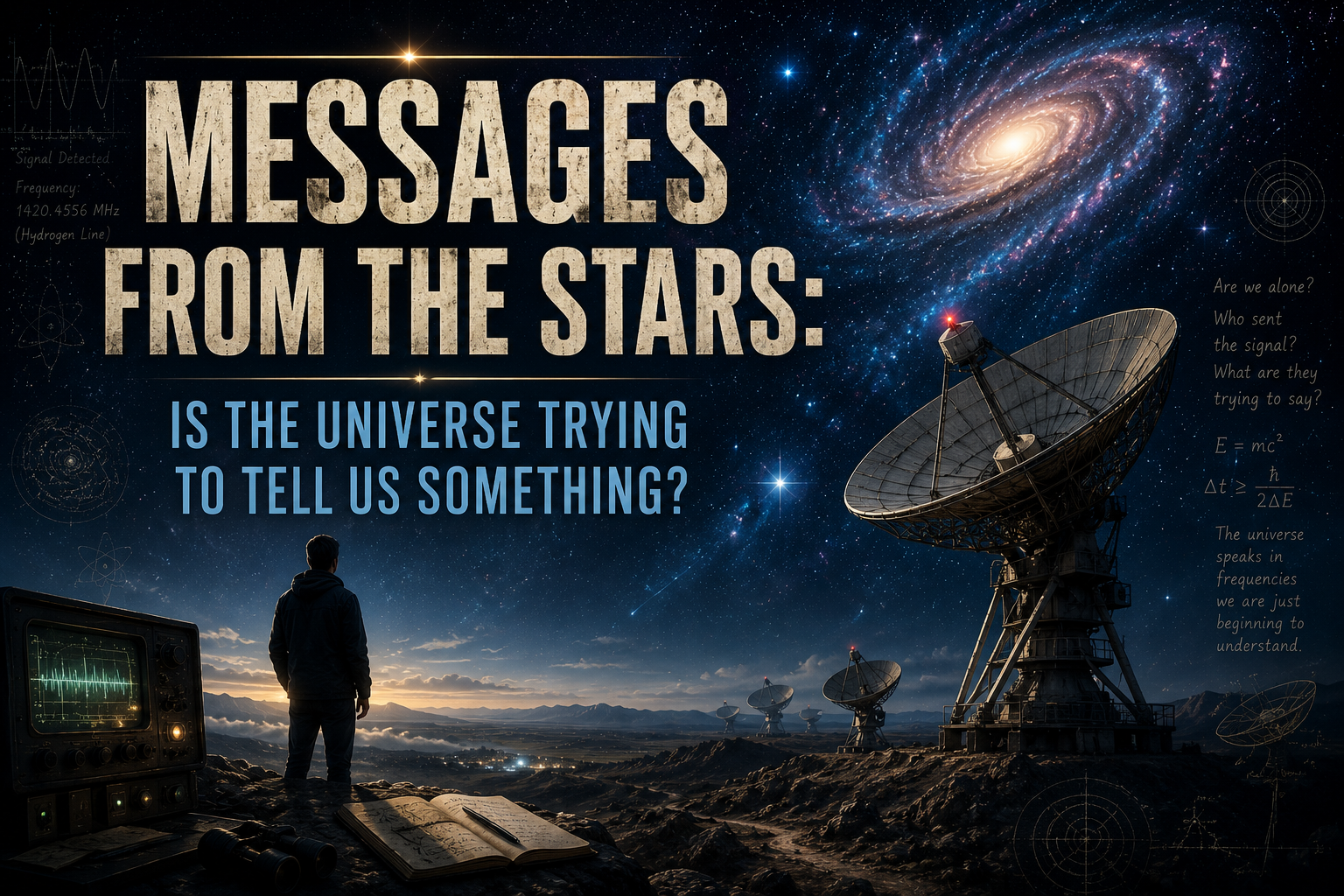
Messages from the Stars: Are We Finally Beginning to Understand the Universe?
On a warm August evening in 1977, something remarkable happened.
At Ohio State University’s Big Ear Radio Observatory, a radio telescope detected a powerful signal coming from deep space. It lasted just 72 seconds, but it immediately stood out from everything astronomers had seen before.
When astronomer Jerry Ehman reviewed the computer printout, he circled the mysterious sequence of numbers and letters and wrote one word in the margin.
“WOW!”
That simple note became the name of one of astronomy’s greatest mysteries.
Nearly fifty years later, no one knows exactly what produced the signal.
Was it an unusual natural phenomenon? A rare cosmic event? A transmission from an intelligent civilization? Or was it simply a coincidence unlike any we’d ever witnessed?
We still don’t know.
But perhaps the most fascinating question isn’t what sent the signal.
It’s whether humanity is finally learning how to listen.
—
The Universe Is Far From Silent
When most people imagine space, they picture silence.
An endless black emptiness stretching beyond imagination.
In reality, the Universe is alive with activity.
Every second, Earth is flooded with invisible energy.
Radio waves travel through space.
Gamma rays burst from distant galaxies.
X-rays pour from violent cosmic events.
Gravitational waves ripple through the fabric of spacetime itself.
Stars pulse like giant beacons.
Black holes collide.
Neutron stars spin with astonishing precision, sending beams of radiation sweeping across the cosmos like enormous celestial lighthouses.
To astronomers, the Universe isn’t silent at all.
It’s performing an endless symphony.
Most of the notes are familiar.
Some remain completely unexplained.
Those are the ones that keep scientists searching.
—
The Signal That Never Came Back
The WOW! Signal remains unique because it possessed several characteristics scientists would expect from an intentional transmission.
It was narrow-band.
Exceptionally strong.
Precisely located.
And then…
It disappeared.
For decades, radio telescopes around the world have returned to the same region of space hoping to hear it again.
Nothing.
No second transmission.
No confirmation.
No explanation.
Sometimes the silence that follows a mystery can be even more intriguing than the mystery itself.
—
Strange Signals Continue to Arrive
The Universe, however, wasn’t finished surprising us.
In recent years astronomers have discovered an entirely new phenomenon known as Fast Radio Bursts, or FRBs.
These incredibly powerful flashes of radio energy last only milliseconds, yet in that tiny fraction of time they can release as much energy as our Sun produces over several days.
Some appear only once.
Others repeat.
A few seem to repeat on surprisingly regular schedules.
Scientists have proposed numerous explanations, including magnetars, neutron stars, collapsing stellar remnants, and other exotic cosmic events.
Some observations fit these theories.
Others do not.
Each new discovery answers one question while creating several more.
—
Is Space Really Empty?
For centuries we imagined space as little more than a giant vacuum.
Modern physics paints a far more fascinating picture.
Space bends.
It stretches.
It ripples.
Gravitational waves travel across billions of light-years, subtly distorting space itself as they pass.
Some theoretical physicists have even suggested that information may be one of the most fundamental building blocks of reality.
If that’s true, then perhaps the Universe is less like empty space and more like an unimaginably vast information network.
If information can never truly disappear…
What else might still be out there waiting to be discovered?
—
The Invisible Universe
One of the greatest surprises in modern astronomy is how little of the Universe we can actually see.
Every galaxy.
Every star.
Every planet.
Every living thing.
Everything we’ve ever observed accounts for only a small fraction of reality.
Scientists estimate that roughly 85 percent of all matter in the Universe is invisible.
We call it dark matter, not because it’s dark, but because we simply don’t know what it is.
It doesn’t emit light.
It doesn’t reflect light.
We can’t photograph it directly.
Yet galaxies refuse to behave as they should without it.
Something unseen appears to be holding enormous cosmic structures together.
It’s like reading a novel where most of the pages have been torn out.
We’re trying to understand the story while missing most of the book.
—
The Even Greater Mystery: Dark Energy
If dark matter is mysterious, dark energy is even more astonishing.
Instead of pulling the Universe together, it appears to be doing the opposite.
The expansion of the Universe isn’t slowing down.
It’s speeding up.
Something is pushing galaxies farther apart with every passing second.
Scientists estimate that nearly 70 percent of the Universe is made of this unknown form of energy
We gave it a name.
But naming something isn’t the same as understanding it.
Dark energy remains one of science’s greatest unanswered questions.
—
Could Our Universe Exist Inside a Black Hole?
Among the more fascinating ideas in theoretical physics is one that sounds almost impossible.
What if our Universe began inside a black hole?
Some mathematical models suggest that when a massive star collapses, it might not simply disappear forever.
Instead, it could give birth to an entirely new universe.
From inside that newborn universe, everything would appear perfectly normal.
Space would expand.
Time would flow.
Galaxies would form.
Stars would ignite.
Life could eventually emerge.
If this idea is correct, every black hole might contain another universe.
And perhaps our own Universe began the same way.
It’s an extraordinary possibility.
While still highly speculative, it’s one that physics has yet to completely rule out.
—
Ancient Eyes Looking Toward the Sky
Humanity’s fascination with the heavens didn’t begin with modern telescopes.
For thousands of years our ancestors carefully observed the skies above them.
The Antikythera Mechanism demonstrated astonishing astronomical knowledge.
The Piri Reis Map continues to challenge historians.
The Baghdad Battery raises intriguing questions about ancient technology.
The Voynich Manuscript remains undeciphered.
The mysterious Dropa Stones continue to inspire debate.
Whether these artifacts represent forgotten knowledge, misunderstood history, or simply unanswered questions, they remind us that curiosity has always been one of humanity’s defining traits.
—
Perhaps the Greatest Mystery Is Ourselves
As mysterious as the Universe may be, one puzzle remains even closer to home.
Consciousness.
Science understands neurons.
Electrical impulses.
Brain chemistry.
Yet no one can fully explain why awareness exists.
How does matter become conscious?
Why should the Universe produce beings capable of wondering about the Universe itself?
Perhaps consciousness is simply an evolutionary accident.
Or perhaps it is one of reality’s most remarkable achievements.
Carl Sagan famously suggested that we are a way for the cosmos to know itself.
Nearly half a century later, those words feel just as profound.
—
The Value of Wonder
History has taught us one lesson over and over again.
Every generation believes it has nearly figured everything out.
Every generation eventually discovers how much it still doesn’t know.
There was a time when meteorites were dismissed as impossible.
Until they weren’t.
Continents couldn’t move.
Until they did.
Black holes were considered mathematical curiosities.
Until we found them.
Science advances because it remains willing to question itself.
Its greatest strength has never been certainty.
It’s curiosity.
—
The Conversation Is Just Beginning
Perhaps every mystery we’ve discussed has an ordinary explanation waiting to be uncovered.
Or perhaps the Universe has been speaking to us all along.
Through radio signals.
Through gravity.
Through mathematics.
Through ancient civilizations that looked toward the same stars we study today.
And through humanity’s endless desire to ask one more question.
Whatever the answers turn out to be, we are living in an extraordinary moment.
New observatories are peering farther into space than ever before.
Artificial intelligence is revealing patterns hidden inside mountains of astronomical data.
Every year brings discoveries that once belonged only to science fiction.
The next great breakthrough may happen tomorrow.
Or perhaps it’s already sitting quietly inside data we’ve yet to fully understand.
Until that day comes…
We’ll keep listening.
—
Continue the Investigation
If mysteries like the WOW! Signal, dark matter, the Black Knight Satellite, ancient artifacts, and the possibility of parallel universes capture your imagination, then join us for the latest episode of The NextWorld Podcast.
Messages from the Stars: Exploring the Mysteries of the Universe with Dr. Adrian Murphy
Join Sir Edward and theoretical physicist Dr. Adrian Murphy as they explore strange cosmic signals, unexplained astronomical discoveries, and some of the biggest unanswered questions in modern science.
Because every great discovery begins with someone willing to ask…
“What if?”
The truth is always stranger than fiction… and fiction is just as real as the truth.
—
Click here to listen to Episode 18 on the NextWorld Podcast hosted by Sir Edward